Curriculum
Preschool Three Year Olds:
Discovery and exploration are key as we embrace being three years old. Each day begins with a creative experience in learning about our best friend, Jesus. Throughout the year, we learn a wonderful blend of Old and New Testament stories that teach us valuable lessons. Utilizing components of the High Scope approach, children engage in experiential learning. Using a variety of activities, children will explore math, literacy, science, creative representation, music, and social skills.
A full size gym and an exciting outdoor play yard are incorporated into lesson plans as well. Parent involvement is encouraged through volunteering for Classroom Helpers, field trip chaperons and parties.
Preschool Four Year Olds:
Our Four Year Old program consists of a developmental approach to teaching readiness skills that help prepare children for a successful entry into Kindergarten. We provide a variety of “hands-on” experiences that assist in exposing our students to letters, numbers, shapes, colors, science, music, and language. In addition, we provide opportunities through learning centers, which create opportunities for small group interaction with the teacher. Thematic units provide additional opportunities for students to expand upon their previous knowledge, while generating curiosity and enthusiasm for learning. Field trips are utilized to further explore concepts outside of our building.
In all that we do, we strive to increase each child’s knowledge regarding their Savior, Jesus Christ, and to enhance that personal relationship. Jesus’ love is woven throughout our entire school year, and we will be involved with prayer, praise songs, and worship experiences on a daily basis. This is the very heart of our program.
Kindergarten:
Our Kindergarten program offers a variety of options. Parents may select to enroll their child in a full-time program or various part-time options. However, no matter the length of the day, the focus will always be based on God’s love and His grace. The Kindergarten religion curriculum focuses upon building a personal relationship with Jesus. Utilizing stories from both the Old and New Testament, students will learn about God’s amazing love for them and how we can apply Biblical truths to our lives today.
Rigby’s “Literacy by Design” is the curriculum that we are currently implementing in grades Kindergarten through Grade 5. Literary concepts that are introduced in Kindergarten include letter and word recognition, syllabic awareness, phoneme segmentation, phonemic matching, and vowel recognition. Students are instructed in both small and large group settings. Writing is also a strong component of this balanced literacy program. Non-fiction writings constitute 40% of the stories presented, which also strongly supports our science and social Studies curriculum.
Kindergarten students develop mathematical skills utilizing the Saxon Math Series through numerous “hand-on” activities. The Kindergarten curriculum introduces students to the numbers 1 - 110 by counting by 1’s, 2’s, 5’s, and 10’s. Concepts such as graphing, telling time, number patterns and currency, estimating, and measuring are introduced in the Kindergarten curriculum.
Extra curricular opportunities such as computers, library, physical education, and music also play a role in our Kindergarten curriculum.
First Grade:
Reading is an exciting adventure of discovery and treasure in first grade! The Rigby “Literacy by Design” curriculum continues to increase first grade students’ knowledge of words with various forms of non-fiction and fictional genres. First grade is an exciting time for formulating foundational reading strategies. Making connections, predictions, conclusions, as well as summarizing, retelling, determining the main idea, and reading for details are just a few of the very important skills that will be learned in first grade.
First graders are able to conceptualize mathematical concepts more successfully when utilizing math manipulatives and mental math strategies, which we put to use in our curriculum. First graders will expand their concepts of numbers up to three digits, learn the fundamental concepts of addition and subtraction, work with fractions, and measurement, as well as build upon previous mathematical experiences.
The first grade science curriculum focuses on life, earth, and physical science. A few highlights include weather, matter, push and pull, and exploring the properties of solids, liquids, and gases.
During social studies, first graders learn about key historical figures, in additional to characteristics of neighborhoods, communities, and community helpers. Through other units, students will learn how to be responsible Christian citizens.
The saving acts of Jesus are discussed and applied to each student’s daily life. First graders recognize Jesus as their Savior, as well as God’s Only Son. The first grade curriculum discusses the concepts of sin and forgiveness; children learn to see themselves as reconciled and redeemed children of God. Students also memorize weekly Scripture verses.
Second Grade:
Second grade is an amazing journey of learning exploration as we encounter all aspects of the curriculum. Reading instruction occurs through a combination of whole class instruction, small group strategic reading, and independent reading. Spelling is taught within the reading curriculum with an assigned spelling list administered every week. Writing instruction occurs across the curriculum and focuses on the writing process. The math curriculum builds upon previous mathematical concepts but also introduces the concepts of multiplication, geometry, and problem solving skills.
The science curriculum has components of life, physical, and earth sciences with specific units in plant life, the water cycle, space, and simple machines, as well as heath and nutrition.
Social Studies allows students to learn more about the beginning history of the United States. Map skills are also very important concepts that are taught.
Although, Jesus is integrated into every aspect of the curriculum, we also learn about God and His gift of love and salvation as demonstrated throughout the Old and New Testaments. Student will learn the key concepts of Law, Gospel, repentance, forgiveness and God’s grace. Memory verses are also shared twice a week.
Third Grade:
Third Grade is the year responsibility starts to shift to the student. Third graders fill out assignment books to help them keep track of their assignments. They learn how to study for tests and write in cursive.
In math the main focus is on multiplying and dividing. Everyday we review time, patterns, money, the calendar, and a problem of the day. After the lesson is taught, the third graders complete Side A of their worksheet in class and correct it. Side B is done at home and brought back the next day, so they are reviewing the concept three times each day.
Our Literacy program consists of whole group instruction, small group instruction, independent reading, vocabulary, fluency, phonics, and writing. Third graders learn eight key comprehension strategies though modeled reading, shared reading, interactive reading, small group reading, and independent reading. They practice their writing though modeled writing, shared writing, interactive writing, and independent writing.
Our social studies program teaches the third graders about different communities in our country and around the world. We discuss how these communities are similar and differ. We also learn about how our U.S. and state governments work. Throughout the year we learn the state capitals.
Our science curriculum consists of hands on activities and reading the Science textbook content. We learn about our digestive system and how our bodies protect us from diseases. We also study the solar system, plants, and animals. Third grade students are also introduced to the “Scientific Method”.
The most important thing that we learn in third grade is about our Savior, Jesus Christ. Everyday we have devotions and religion where we learn about what God has done for us. We learn memory verses to go along with the Bible stories. On Wednesdays we worship together with the school in chapel. Jesus is a part of everything we do.
Fourth Grade:
Fourth grade is a very important year of transition and growth from the elementary grades into the middle grades. It is a year when students start to become less dependent on their parents’ assistance and more independently responsible for completing their assignments.
Math is challenging because students now have their own textbooks and are responsible for copying the math problems and showing their work. Previous mathematical concepts are expanded upon, in addition to multiplication and division, as well as incorporating fractions into these concepts.
Fourth grade students expand upon the “Scientific Method” and utilize this process while exploring topics such as living organisms, the earth, animals, magnetism, and water.
Fourth grade is the year when all students in the state of Michigan will journey through Michigan’s history. Through this endeavor, we will also learn about Michigan’s geography, its economic development, and governmental structure.
“Literacy by Design” is an innovative approach to the teaching of literacy. During reading instruction, students will participate in large and small group instruction. Writing is an instrumental component to this balanced literacy approach allowing for students to express themselves in written fashion on a daily basis.
However, Christ is the most vital component of our curriculum. Each day, students learn about His love. Daily religion classes emphasize this concept, but this Christian theme is apparent in every class throughout the day.
Fifth Grade:
The fifth grade students spend a great amount of time reading the Bible and learning from the Old and New Testament. They learn about the beginnings of the Lutheran faith through a unit on the Reformation. In social studies the children study Ancient civilizations found in the Eastern Hemisphere. These studies include places read about in the Bible during religion instruction.
A major focus in fifth grade is on reading and writing. The children keep a writer’s notebook creating imaginative stories and keeping reflective writings about events that occur in their lives. The children take much of their writing through the entire writing process in order to collect several published pieces. Literacy instruction occurs in both large group and small group settings where students are classified according to individual reading levels. The eight parts of speech are taught at this level to help insure that proper grammar is used by the children in both their writing and oral language.
Science discoveries occur through hands-on experiments as well as text book readings and comprehensive discussions. The topics of study for science are plants, weather, sound, light, matter, the Earth, ecosystems, and the human body.
The Math curriculum is Saxon Math, which is structured on sound educational practices of incremental development and continual review. Through constant repetition, the children learn multiplication, division, powers, fractions, decimals, percents, estimation, number theory, geometry, and problem solving.
The fifth grade classroom is one that fosters a safe and happy environment where students are able to learn and grow by interacting with each other and sharing the love of Jesus through words and actions.
Middle School: Sixth, Seventh, and Eighth Grade Departmentalization
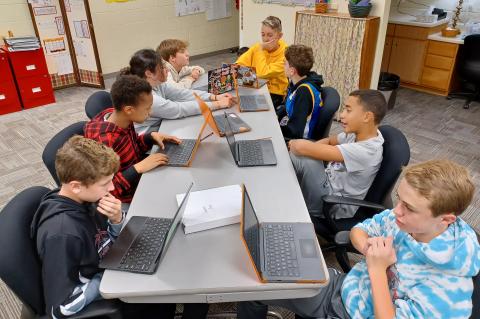
As a departmentalized staff, each staff member manages a grade level Homeroom, as well as teaches in their specific academic strength.
Religion is an integral aspect of our curriculum. As a result, each Homeroom begins their day with the same. Grade 6 focuses on the life, death, and resurrection of Jesus Christ. Grades 7 & 8 study Old and New Testament respectively. Outreach projects support the curriculum and faith development throughout the school year. Complimentary to faith development is the memorization of Scripture, thus enabling the learner to retrieve its nourishment in times of rejoicing, sorrow, and encouragement.
English allows students to practice their basic grammar skills, as well as demonstrate their mastery of the same through the writing process. Spelling provides access to vocabulary and its usage.
Literature in Grade 6 engages students in the critical thinking process, which in turn leads to the evaluation of content and the ability to communicate well in written form. Grade 7 instruction continues to develop the progression of critical thinking in conjunction with the writing processes, which demonstrates the level of in-depth analysis utilized. Finally, Grade 8 students have the opportunity to master the skills developed in the past two years; thus, students are engaged in many formal writing endeavors and reading of novels, in addition to selections from the literature anthology.
Math in the Upper Grades utilizes Saxon Math textbooks. This series is known as a spiral review text. One or two new concepts are presented each day and then the assignment is a compilation of thirty problems that include recurring practice on concepts learned in previous lessons.
- 6th Grade Math - The sixth grade course is a basic mathematics course, which covers many areas of math including operations with whole numbers and decimal numbers; algebra is introduced; geometry concepts are taught, as are ratio and proportion. Much time is spent working with and understanding fractions and how to manipulate them.
- 7th Grade Math Courses - The seventh grade course presents many new concepts within various areas of mathematics. Algebra is a key component, and students learn to solve equations. Ratios and proportions are used extensively to solve real world problems. Much work is also done with integers and how they fit into the world of real numbers. Advanced Math placement is available starting in seventh grade. These students are introduced to the eighth grade curriculum and will, upon completion of the year, move into Algebra.
- 8th Grade Math Courses - The eighth grade math curriculum follows the Saxon Algebra 1/2 textbook. Algebra is the main focus of the course, which concentrates on preparing eighth grade students for high school math. Much work is also done using ratio and proportion to solve real world problems. Those students who completed the eighth grade curriculum in seventh grade take Algebra. They graduate prepared for the next advanced level of math in high school.
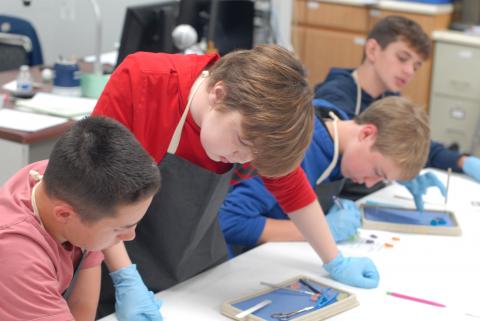
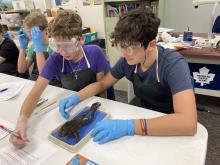
ScienceStudents learn various aspects of Earth, Life, and Physical sciences through lab work as well as hands on experiences. Science Fair participation is required in grades 6 and 8, while grade 7 students are given the option.
Social Studies in sixth grade introduces both the Western and Eastern Hemispheres. Students study the geography, history, and cultures of countries and/or regions of the world. Students also complete projects to develop their understanding of physical relationships of specific countries in areas around them.
History in seventh and eighth grades presents American history from the Native Americans who first came to North America to the present. Grade 7 starts at the beginning and studies up to the causes of the Civil War. Grade 8 continues on from there and carries their learning to the present. Time is also spent learning about citizenship, the Constitution, and our form of government.